

A Roman at the Edge of the World Part 1
- Clan of the Ancestors

- Jul 29
- 4 min read
Updated: 6 days ago
Before we journey into the mist, a word on how we look at the past... When we peer back into the ancient world, it is easy to recoil from practices that seem brutal, strange, or incomprehensibly extreme. We read classical accounts of the Celts—their ritual headhunting, their display of severed skulls in cedar chests, or the whispered druidic sacrifices in dark oak groves—and we congratulate ourselves on how far human civilization has advanced. But history is a mirror, not a museum. If the ancient Celts mounted the heads of fallen foes upon their doorframes or horse harnesses to declare victory and display prestige, consider our modern parlors, where we hunt, mount, and boast over the severed heads of noble wild animals for sport. And if the Druids offered human lives to appease the unseen forces of nature, do we not perform our own rituals of sacrifice today? Ouificed the physical body; in our modern digital landscape, we offer up the spirit, dignity, and reputation of those who dare to disagree with our tribe, casting them out into social exile. The story that follows is told through the eyes of a Roman envoy named Marcus, who crossed the Irish Sea into an island Rome never conquered. Every detail of fashion, warfare, worship, and daily life recorded in his journal is drawn directly from the historical and archaeological record of early Ireland. As you read his dispatches, ask yourself not only how strange their world was—but how closely it mirrors our own. Part 1: Across the Misty Sea: Vanity, Woad, and the Trousers of Hibernia
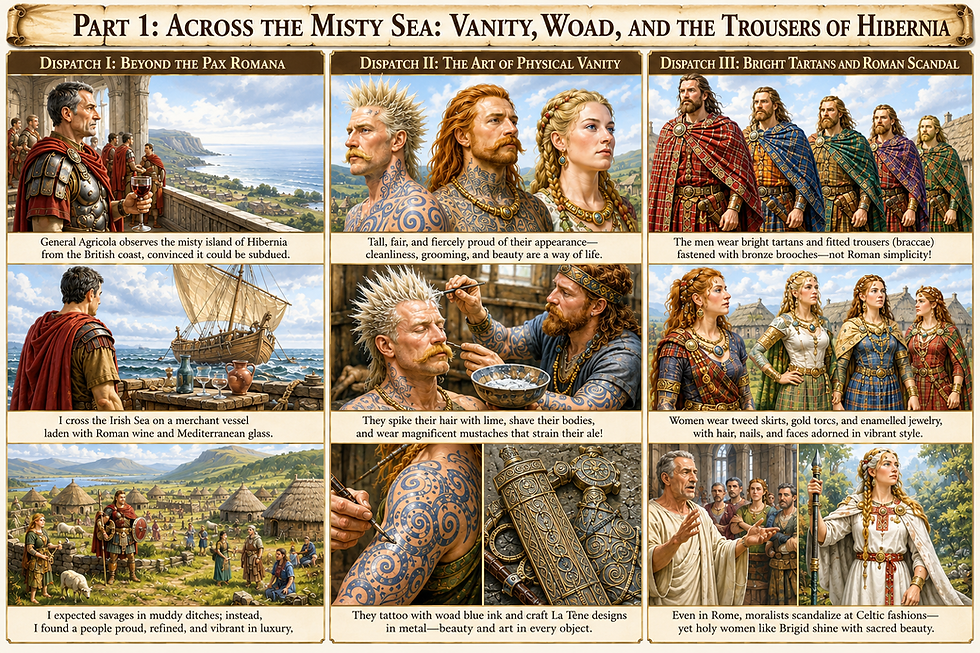
Dispatch I: Beyond the Pax Romana To the Senate in Rome, the land across the western ocean is merely Hibernia—a dark realm of sea-fogs, bog-water, and lawless clans beyond the reach of our paved roads. General Agricola eyes its green hills from the heights of the British coast, remarking over spiced wine that a single Roman legion could bring the entire island under the eagle. But Rome has never set foot here as a conqueror. While the continental Celts of Gaul adopted our Latin tongue, wrapped themselves in our wool toga, and sought favor with Caesar, these islanders in Ireland, Wales, and the cold north of Caledonia remained geographically removed. Their language—born near 1000 BC along European trade routes of salt, wine, and bronze—remains untamed by Latin grammar. I crossed the Irish Sea on a merchant vessel laden with Italian wine and Mediterranean glassware. I expected to find unwashed savages hiding in muddy ditches. What I found was a people utterly obsessed with physical perfection, personal vanity, and vibrant luxury. Dispatch II: The Art of Physical Vanity The Irish are remarkably tall, well-built, and fiercely proud of their stature. Both men and women possess fair skin, striking blue eyes, and long hair ranging from bright blond to fiery red. Cleanliness among them is not a task; it is a cultural obsession. Never did I see a nobleman or warrior in soiled or ragged garments. Indeed, their society imposes strict social penalties for neglect of the body: obesity is legally punished, and any man whose waistline exceeds the standard measure of the leather belt is fined or publicly shamed. Their grooming habits are both fascinating and terrifying to a Roman eye. The men whiten and stiffen their thick hair using lime water—a chalky alkaline mixture—pulling it back into rigid, spiked strands that resemble the crests of our iron helmets. They shave their body hair smooth, yet noblemen cultivate sweeping, long mustaches that completely veil their mouths. When they dine, food becomes entangled in these glorious mustaches, and when they drink, the hair acts as a natural strainer for the honeyed ale passing through! Beneath their garments, they tattoo their flesh with swirling, intricate patterns drawn in blue ink derived from the native woad plant. Their metalworkers are unequaled across the western world, hammering bronze and iron into unique, abstract, and geometric patterns curvilinear La Tène spirals that grace everything from drinking horns and chariots to horse harnesses and sword scabbards. Dispatch III: Bright Tartans and Roman Scandal We in Rome know the dignified simplicity of the toga. The Celts abhor plainness. The men wear brightly colored, tartan-patterned tunics fastened at the shoulder with polished bronze or iron brooches. Unlike the open garments of Greece and Rome, Celtic men cover their legs entirely with fitted trousers known in their tongue as braccae (breeches). The women are no less magnificent. They wear long, sweeping skirts woven from heavy tweed with bold, checked patterns that wrap tightly around the waist and extend to their calves. Around their necks, they wear heavy metallic rings of twisted gold and bronze called torcs, accompanied by enameled armlets, anklets, and necklaces strung with green glass beads and Mediterranean coral. Their long hair is intricate, bound in braided tresses held by decorative pins. They paint their faces with rouge for their cheeks, dark powders for their eyes, and polish upon their nails. Indeed, word of these Gaelic fashion trends has already drifted across the empire. I recall Roman moralists complaining that our own noble ladies in Rome have begun imitating the cosmetics and hair dyes of these Atlantic women! Even their holy women display this flair. I observed a young priestess—a woman named Brigid, who walks in the traditions of the Druid order—clad in a solid robe of stark white, draped in a speckled cloak hooked with a gold pin, red embroidered tunic, and sandals bound with golden clasps. Her hair hung in three thick tresses, two coiled gracefully upon her head and the third brushing her calves as she held a heavy weaving rod inlaid with pure gold. There are no miserable barbarians in the mist. They are a people of color, vanity, and proud craft—and I have only begun to learn the dangerous rhythm of their world.


Comments