

Diarmuid and Gráinne
- Clan of the Ancestors

- Jul 29
- 3 min read
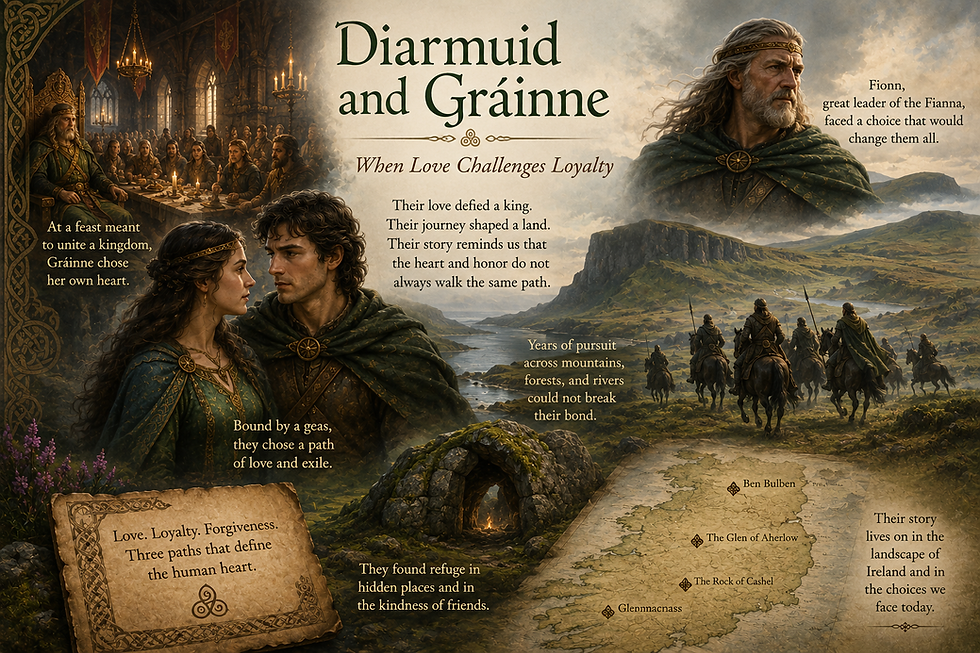
When Love Challenges Loyalty
Not every great story of beginnings is about the creation of the world.
Some are about the creation of a choice.
Few Irish legends capture that truth more powerfully than the story of Diarmuid and Gráinne. Passed down through the Fenian Cycle, it is remembered as one of Ireland's greatest tales of love, loyalty, and tragic consequence.
At its heart are three remarkable figures.
Fionn mac Cumhaill, legendary leader of the Fianna and one of Ireland's greatest heroes.
Gráinne, daughter of the High King of Ireland, celebrated for both her beauty and her determination.
And Diarmuid Ua Duibhne, one of Fionn's finest warriors, admired not only for his courage but for his unwavering loyalty.
Their lives become forever intertwined at a feast intended to celebrate a royal marriage.
A Choice No One Expected
Gráinne has been promised in marriage to Fionn.
The match is politically wise and socially expected, yet as the celebration begins, her attention is drawn elsewhere.
Across the hall stands Diarmuid.
Young.
Honorable.
And entirely devoted to the man she is expected to marry.
In that single moment, the future changes.
Knowing Diarmuid would never willingly betray his chieftain, Gráinne invokes one of the oldest powers in Irish tradition. a geas, a sacred vow that binds a person beyond ordinary choice.
Under its power, Diarmuid cannot refuse her.
Together they leave the feast, beginning one of the most famous journeys in Irish mythology.
The Long Pursuit
Fionn's anger is immediate.
Not only has his bride fled, but she has done so with one of his most trusted companions.
What follows is not a single battle, but years of pursuit across Ireland.
The lovers seek refuge in forests, mountains, caves, and hidden valleys. Friends offer shelter. Others refuse, fearing Fionn's wrath. Every landscape becomes both sanctuary and danger as the couple struggles to remain one step ahead of the warriors searching for them.
Along the way, the story becomes deeply woven into Ireland's geography. Hills, rivers, caves, and ancient sites across the island are still associated with places where Diarmuid and Gráinne are said to have rested during their long flight.
In this way, the landscape itself becomes part of the legend.
A Fragile Peace
Eventually, time softens even old grievances.
A reconciliation is arranged.
For a brief moment, it appears the years of conflict have finally come to an end.
Then fate intervenes.
While hunting on the slopes of Ben Bulben, Diarmuid is attacked by a great enchanted boar and suffers a mortal wound. Fionn possesses the ability to save him. By allowing healing water to pass through his hands, he can restore life itself.
Twice he gathers the water.
Twice he lets it slip away.
Whether from lingering resentment, wounded pride, or the inability to forgive, Fionn hesitates until it is too late.
Diarmuid dies, and one of Ireland's greatest love stories ends in sorrow.
Why Their Story Endures
The legend of Diarmuid and Gráinne has survived for centuries because it refuses to offer simple heroes or villains.
Gráinne follows her heart, but her choice brings hardship.
Diarmuid honors love, yet struggles against his loyalty.
Fionn remains a legendary leader, but reveals how even great people can be undone by jealousy and pride.
The story asks a timeless question:
What do we do when two deeply held values demand opposite choices?
Love and duty.
Honor and desire.
Forgiveness and resentment.
Few lives escape those tensions entirely.
Perhaps that is why this ancient Irish tale continues to resonate.
Its ending reminds us that our greatest victories are not always won in battle.
Sometimes they are found in the grace to forgive before time makes forgiveness impossible.
And sometimes the choices that shape our lives are not between right and wrong—
but between two things we wish we could keep together.


Comments