

The Inherited Name
- Clan of the Ancestors

- Jul 29
- 2 min read
Updated: Aug 4
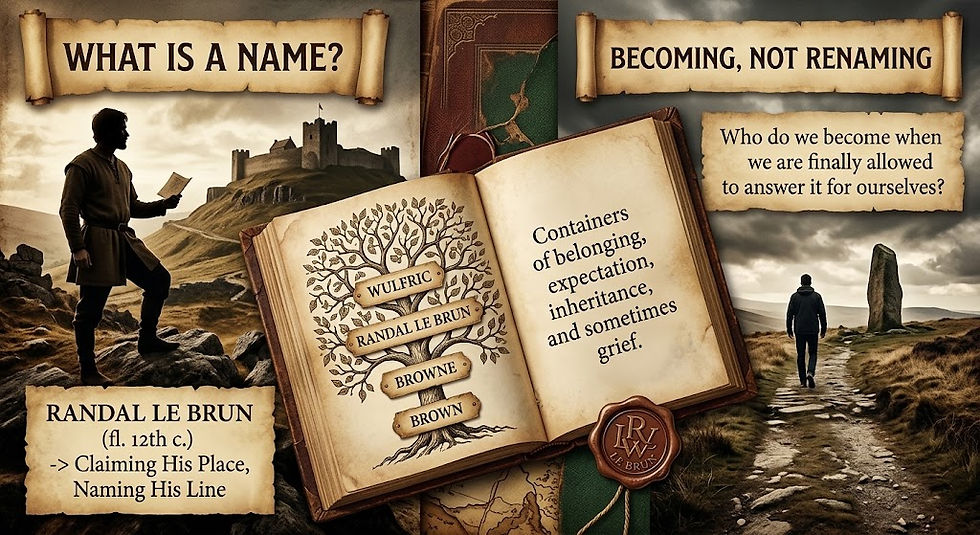
Imagine standing in a world where land, title, and identity were handed down through established bloodlines—and you were born without a clear place in that line. What do you do when the system expects you to be invisible? You give yourself a name history cannot ignore. What Is a Name?
A name is often the first thing we are given—and one of the last things we fully understand. It arrives before memory, before language, before choice. It is spoken over us, written into records, repeated until it feels inseparable from who we are.
In genealogy, names are the thread we follow back through time. They appear in registers, census lines, ship manifests, wills, and church books, connecting parents to children, families to places, and the living to the dead. But a name carries more than record-keeping value. It holds:
How someone was claimed—or not.
How they were seen—or overlooked.
How they were remembered—or erased.
Without a name, someone can disappear entirely, leaving only a blank space where a life once stood.
The Story of Randal, Son of Wulfric To understand how names shape us, we can look back to a pivotal moment in our own lineage: the story of Randal, son of Wulfric. When Randal inherited land, he found himself facing a distinct challenge. Unlike established family lines whose inherited names carried automatic prestige and land rights, Randal needed a way to set himself apart—to distinguish his house from others who relied purely on ancestral momentum. In a feudal landscape governed by Norman influences and shifting territorial claims, adopting a distinctive cognomen was both a political move and an act of self-definition. He chose Le Brun (meaning "the brown" or "dark-complexioned"). Why Le Brun? In the medieval period, descriptive epithets were frequently adopted to signal personal characteristics, distinct family branches, or allegiance. For Randal, taking on Le Brun was not merely taking a nickname; it was establishing a distinct branch of the family tree - a mark of identity that carved out his own authority alongside his land inheritance. Over the generations, as Old French merged with Middle and Modern English, the Norman Le Brun shifted: Le Brun⟶Browne⟶Brown What started as a conscious choice by a son of Wulfric to mark his place in the world eventually became the surname carried across centuries, oceans, and legal documents. When a Name Is Set Down or Chosen Not all name changes are accidents of historical spelling. Sometimes, a name is altered by survival, immigration, or deliberate choice. There are moments when a person chooses to separate from or redefine a name. Some changes are acts of survival or acts of reclamation—not to forget the past, but of refusing to be defined solely by its burdens. A name can carry expectations a person cannot live under, or it can become the very tool that allows them to stand in conversation with their ancestry. Names are not static. They are carried, lost, reclaimed, and reshaped. What matters is not whether a name remains unchanged across a thousand years, but whether the person who carries it is allowed to become whole. Reflecting on the Lineage When you look back through your own family tree, do you see names that remained rigid or names that shifted to survive?


Comments