

Before England Was England
- Clan of the Ancestors

- Jul 29
- 3 min read
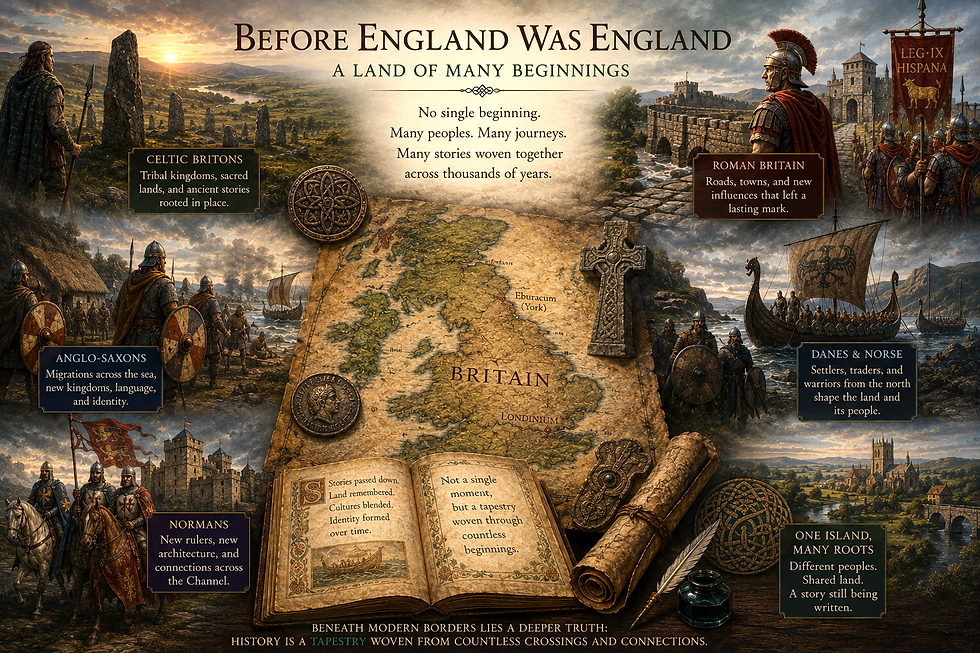
A Land of Many Beginnings
Long before England became a nation, the island was a meeting ground of peoples, languages, migrations, and memory.
There was no single beginning.
The land that would eventually become England was shaped over thousands of years by successive waves of settlement and transformation. Ancient tribal communities gave way to Celtic kingdoms. Roman legions arrived and departed. Anglo-Saxon migrants crossed the North Sea. Scandinavian settlers established new communities along the eastern coast. Norman rulers arrived from across the Channel. Traders, farmers, soldiers, craftsmen, and families moved continually through the landscape, leaving traces of themselves behind.
Each generation inherited something from those who came before.
And beneath them all, the land endured.
A Landscape of Stories
To many of Britain's earliest inhabitants, the land was not an empty wilderness waiting to be conquered.
Rivers carried meaning.
Forests held mystery.
Hills and valleys preserved memory.
Coastlines connected distant worlds.
Long before written history reached the island, people told stories to explain the forces surrounding them and the identities forming within them.
Different regions developed different traditions.
In the southwest, stories emerged of giants, sacred hills, and ancient arrivals from across the sea.
The forests of the Midlands gave rise to traditions of renewal, survival, and the enduring presence of the Green Man.
Northern regions developed cultures shaped by stone, wind, endurance, and later contact with Scandinavian settlers.
In the west, iron-rich landscapes fostered communities built around craftsmanship, labor, and transformation through fire.
These were not yet English stories.
They belonged to Britons, Celts, tribal confederations, seafarers, and regional communities whose identities were tied more closely to place than to nationhood.
Layers Upon Layers
Even the word "England" came later.
Derived from the Old English Englaland—the land of the Angles—it emerged after Germanic migrations reshaped much of southern and eastern Britain following the withdrawal of Rome.
Yet the older layers never disappeared.
Across England, traces of earlier worlds remained.
In place names.
In local legends.
In standing stones and sacred wells.
In burial mounds, seasonal customs, dialects, and stories carried quietly through generations.
The island became not a single culture, but an accumulation of many.
Roman roads crossed older tribal pathways.
Christian churches rose beside sacred springs.
Norse words entered Anglo-Saxon speech.
Norman castles stood above earlier settlements.
Ancient regional identities survived inside newer kingdoms.
England formed gradually through overlap.
A Crossroads of the North Atlantic
This blending became especially important throughout the North Atlantic world.
Scandinavian settlement connected eastern England to Denmark and Norway.
Norman rule carried both Scandinavian and French influences into English identity.
Trade routes linked England to Ireland, Scotland, Wales, the Baltic, and continental Europe long before modern borders existed.
The farther we look into early English history, the more difficult it becomes to separate one people neatly from another.
The roots were already tangled.
Perhaps that is what makes England's story so distinctive.
Unlike cultures centered on a single founding myth or heroic ancestor, England emerged through centuries of adaptation and accumulation.
Migration upon migration.
Memory upon memory.
Influence upon influence.
Its identity was never fixed.
It was continually reshaped by the people who arrived, stayed, departed, and returned.
Why the Story Endures
What fascinates me most about England's origins is that there is no single moment when England suddenly appears.
There is no lone founder standing at the beginning of the story.
Instead, there are countless people whose lives overlapped acrosscenturies.
Farmers clearing fields.
Merchants crossing seas.
Families adapting to change.
Communities learning to live alongside newcomers.
The farther we look into the past, the more familiar this pattern becomes.
Most identities are not born from a single source.
They are layered.
Inherited.
Blended.
Reimagined.
England reminds us that cultures, like people, are rarely defined by one beginning.
They are shaped by many.
And perhaps that is why the story still resonates today.
Beneath modern maps and national borders lies a deeper truth: human history is not a collection of separate stories.
It is a tapestry woven from countless crossings, encounters, and connections.
Before England was England, there were many beginnings.
And many of those beginnings still live beneath the surface today.


Comments