

The Iron Hearth
- Clan of the Ancestors

- Jul 29
- 3 min read
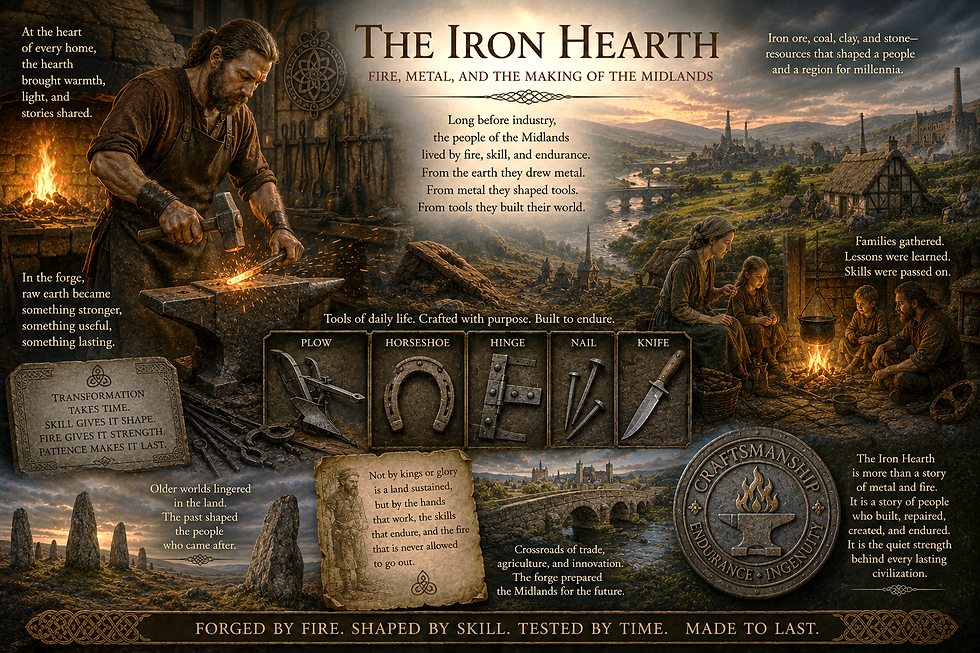
Fire, Metal, and the Making of the Midlands
Long before the factories and foundries of later centuries transformed the Midlands into an industrial center, the people of the region already lived in close relationship with fire and metal.
Beneath the hills and forests of western England lay resources that would shape the identity of the region for thousands of years.
Iron ore.
Coal.
Clay.
Stone.
To ancient communities, these materials were not simply commodities waiting to be extracted.
They were part of the landscape itself.
The people who lived among them learned to transform the earth through patience, skill, and labor.
From this relationship emerged a culture shaped not by grand monuments or legendary kings, but by craftsmanship, practicality, and endurance.
At the center of daily life stood the hearth.
It provided warmth during winter.
Food for the table.
Light in darkness.
A place where families gathered and stories were shared.
The hearth was more than a source of comfort.
It was the heart of the home.
The Makers
Across Britain and northern Europe, certain individuals occupied a unique place within their communities.
They were the smiths.
The makers.
The repairers.
The people who understood how to coax useful things from stone and ore.
To earlier generations, their work must have seemed almost magical.
Metal entered the forge as raw material.
It emerged transformed.
A glowing piece of earth became a plow.
A nail.
A horseshoe.
A hinge.
A knife.
A tool capable of changing daily life.
The forge became a place of transformation.
Fire and skill worked together to create something stronger than either alone.
The Wisdom of the Forge
Stories of master craftsmen survived throughout England and the wider Germanic world.
Figures such as Wayland the Smith became legendary not because they ruled kingdoms, but because they possessed rare knowledge and hard-earned skill.
The smith understood something few others did.
Transformation takes time.
Metal does not become useful in a single moment.
It must be heated.
Hammered.
Shaped.
Tested.
The process demands patience.
The people of the Midlands understood this lesson well.
Life itself often worked the same way.
Communities endured hardship.
Families adapted to change.
Generations learned through repetition and effort.
Strength was not something inherited automatically.
It was forged.
A Culture of Practical Resilience
Unlike myths centered on gods or conquerors, the traditions of the Iron Hearth remained grounded in ordinary life.
The people of the Midlands depended upon practical abilities.
Repairing what was broken.
Building what was needed.
Solving problems.
Working together.
Creating tools that would endure.
Over time, this relationship with craftsmanship shaped the character of the region.
The Midlands became associated with a quieter form of resilience.
Not spectacle.
Not glory.
Reliability.
What mattered most was not appearance.
It was whether something held together when tested.
A bridge.
A plow.
A tool.
A community.
A family.
The same principle applied to all of them.
The Fire Beneath the Future
As waves of migration crossed England—including Anglo-Saxon, Scandinavian, and Norman influences—the Midlands increasingly became a crossroads of agriculture, trade, and technology.
Older traditions blended into newer identities.
Yet the association between the region and skilled labor remained remarkably consistent.
Long before the Industrial Revolution transformed Britain, the foundations already existed.
The forge had been preparing the region for generations.
The habits of craftsmanship, innovation, and practical problem-solving were already deeply rooted in the culture.
The future was being shaped one tool at a time.
Why the Story Endures
What fascinates me most about the Iron Hearth is that it reminds us how much of human history is built by people whose names are rarely recorded.
The farmer who repaired a plow.
The blacksmith who forged a hinge.
The craftswoman who made a tool that lasted for decades.
The builder who constructed a home strong enough to shelter generations.
Most civilizations are not sustained by heroes alone.
They endure because ordinary people perform extraordinary acts of persistence.
The farther we look into history, the more often we find this pattern.
Communities survive because someone keeps the fire burning.
Someone repairs what is broken.
Someone builds what is needed.
Someone teaches the next generation.
The people of the Midlands expressed this truth through the image of the forge.
Stone becomes metal.
Metal becomes a tool.
A tool becomes part of a life.
And through countless small acts of creation, a civilization takes shape.
Perhaps that is why the symbolism of the Iron Hearth still resonates today.
It reminds us that some of the strongest things in history are not born fully formed.
They are forged slowly.
Tested repeatedly.
And made to last.


Comments