

The Tuatha Dé Danann
- Clan of the Ancestors

- Jul 29
- 4 min read
Ireland’s People of Light
Long before Ireland’s kings ruled from Tara, before saints crossed the countryside carrying bells and books, and before the first written histories were recorded, the island belonged to another people.
They were called the Tuatha Dé Danann—the People of the Goddess Danu.
Whether remembered as gods, ancestors, culture bearers, or something in between, they occupy a unique place in Irish tradition. They are not merely characters in a myth.
They are the great civilizing force of Ireland’s earliest stories, bringing knowledge, craftsmanship, wisdom, and sovereignty to the land.
Their story begins not with a journey across the sea, but with an arrival unlike any other.
Arrival in the Mist
The ancient tales tell us that the Tuatha Dé Danann did not come to Ireland by ordinary means.
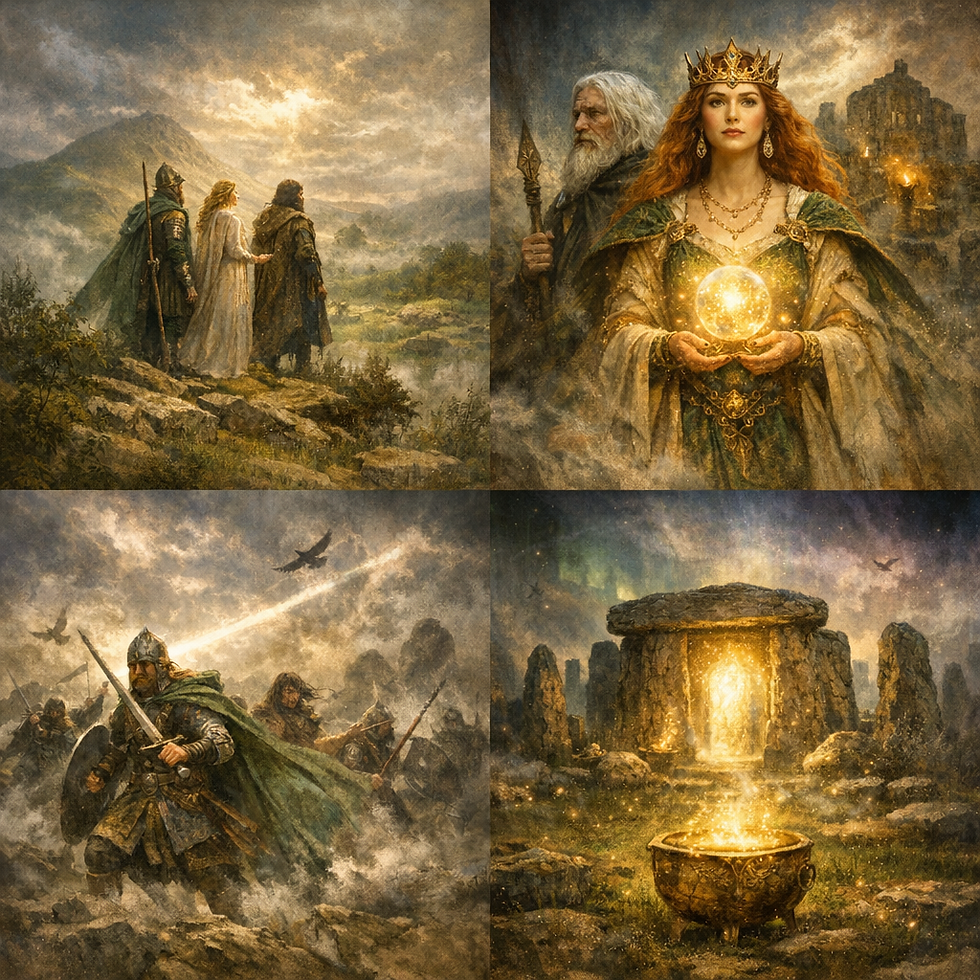
They appeared in dark clouds and thick mist upon the mountains of western Ireland. For three days, the sun itself was hidden. The fog was so dense that the people already living on the island could not see where the newcomers had come from or how many there were.
The mystery was deliberate.
The Tuatha Dé Danann arrived not as wanderers searching for a homeland, but as a people carrying a destiny.
The stories say they came from four northern cities where they had mastered the arts of wisdom, magic, poetry, healing, and warfare. They arrived not empty-handed but bearing treasures that embodied their understanding of how a society should function.
Four Treasures
Each treasure represented more than power.
Each carried a lesson.
The Stone of Destiny (Lia Fáil) symbolized rightful sovereignty. Legend held that it would cry out when touched by the true king of Ireland.
The Spear of Lugh represented skill, courage, and decisive action. Once cast, it never failed to find its mark.
The Sword of Nuada stood for justice. No one could escape its judgment once it had been drawn.
The Cauldron of the Dagda symbolized abundance and hospitality. No one ever left it unsatisfied.
Together these treasures reveal something important about the Irish imagination.
A successful society required balance.
Leadership alone was not enough.
Power required justice.
Justice required wisdom.
Wisdom required generosity.
And all of them depended upon rightful stewardship.
Battle for Ireland
The island was not empty when the Tuatha Dé Danann arrived.
The Fir Bolg already held the land.
What followed was one of the most important conflicts in Irish mythology: the First Battle of Magh Tuireadh.
Yet the story is not simply about conquest.
It is about sacrifice.
During the struggle, King Nuada lost his arm.
To modern readers this may seem a minor detail, but to the ancient Irish it carried enormous significance. A king was expected to be physically whole. Because of his wound, Nuada was forced to surrender his throne.
The lesson is striking.
Leadership was not viewed as a privilege.
It was a responsibility.
Even a beloved ruler could lose his position if he could no longer fulfill the standards required of the office.
Eventually Nuada received a silver arm crafted by the healer Dian Cécht and the smith Credne. Later, the gifted physician Miach restored him completely, allowing him to reclaim his kingship.
The story blends healing, craftsmanship, sacrifice, and restoration into a single narrative—a reminder that broken things can sometimes be made whole again.
The People Beneath the Hills
The most fascinating chapter of the Tuatha Dé Danann story comes at the end.
After generations of rule, they were challenged by a new people: the Milesians.
These newcomers would become the ancestors of the Irish people.
The Tuatha Dé Danann were defeated.
Or so it seemed.
Unlike many conquered peoples, they did not disappear.
They did not sail away.
They did not perish.
Instead, they moved into the landscape itself.
The old stories say they retreated beneath the hills and ancient mounds known as the Sídhe.
There they became the unseen guardians of the land.
Over time, memories of the Tuatha Dé Danann blended with stories of the Aos Sí—the Good Folk, the Fair Folk, and the beings we now call the Fae.
The rulers of Ireland became the people beneath Ireland.
The visible kingdom gave way to an invisible one.
Why Their Story Endures
The Tuatha Dé Danann occupy a special place in Irish memory because they represent more than supernatural beings.
They embody ideals.
Wisdom over ignorance.
Stewardship over possession.
Skill over brute force.
Generosity over greed.
Their transformation into the people of the hills reminds us that power does not always vanish when it becomes invisible.
Sometimes it changes form.
Perhaps that is why their story continues to resonate after centuries.
The Tuatha Dé Danann never truly left Ireland.
They remain in the old stories, the ancient mounds, the place names, and the imagination of a people who have always understood that the world contains more than can be seen.
The mist may lift.
The kingdoms may fall.
But some stories simply move beneath the surface and wait to be remembered.


Comments